Case Report | DOI: https://doi.org/10.31579/2690-4861/080
*Corresponding Author: Dr Prarthana Gokarn, DOMS, DNB Narayana netralaya, Near Iskcon Temple, 121/C, Chord Rd, 1st R Block, Rajajinagar, Bengaluru, Karnataka.
Citation: K Nagaradh, P Gokarn. (2020) Post typhoid retinitis and neurosensory detachment. International Journal of Clinical Case Reports and Reviews. 5(1);DOI: 10.31579/2690-4861/080
Copyright: © 2020 Prarthana Gokarn, This is an open-access article distributed under the terms of the Creative Commons Attribution License, which permits unrestricted use, distribution, and reproduction in any medium, provided the original author and source are credited.
Received: 21 October 2020 | Accepted: 22 December 2020 | Published: 29 December 2020
Keywords: typhoid; retinitis; vasculitis; retinal detachment
Typhoid fever is an acute infectious disease capable of rarely producing ocular complications. These complications are usually seen after the third week, and is notoriously called, as the "Week of complications" by direct invasion or by allergic immune mediated reactions. It can present as uveitis, vasculitis, choroiditis, endophthalmitis or panophthalmitis. We here present an 18 year old boy presenting as retinitis with severe exudation and neurosensory detachment and which was managed successfully with steroids.
Enteric fever is a systemic disease caused by gram negative bacteria Salmonella typhi or Paratyphi. Abdominal pain and fever are the characteristic features of the disease. A very high incidence of disease is reported in India and other developing countries due to poor sanitation, access to safe clean drinking water and hygiene among individuals [1, 2].
Typhoid fever related eye manifestations are rare and can lead to blindness and other complications if left undiagnosed and not treated. It has an varied presentation in the form of uveitis, choroiditis, vasculitis, retinitis, endogenous endophthalmitis and even panophthalmitis [3, 4].
Ocular manifestations are usually seen after the third week, and is notoriously called, as the "Week of complications" either due to direct invasion of organism or by an hypersensitivity reaction to organism [5]. Here we want to report an similar case of retinitis, vasculitis and neurosensory detachment developing post typhoid fever in an young individual and which was successfully managed with course of steroids.
We present an 18 year old male native of Bihar residing in Bangalore with chief complaints of DOV in both eyes of 3 days duration with h/o fever 3 weeks back. The reports carried by him revealed he was found positive titers for typhoid bacillus with titers of 1:320 for O antigen and 1:160 for H antigen. He was treated with antibiotics Oflaxacin 400 mg for 2 weeks elsewhere. His fever subsided after initiation of antibiotics but developed diminution of vision 3 days back. His best corrected vision in his right eye was CF at 3mts and in left eye 20/200. His slit lamp examination of the anterior segment of eye was within normal limits.
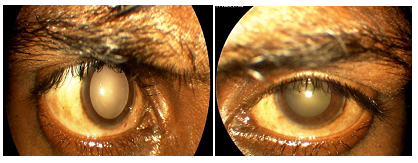


DISCUSSION:
Very few cases of typhoid related retinitis have been reported previously.[6.8] Retinits occuring post fever has been reported in many other infections like malaria, chickungunya, and viral fevers.[9,10] The pathogenesis in most of these conditions has been attributed to immune mediated reaction to microbial antigens by the host cells.[9] Our patient was diagnosed as post typhoid retinitis as he had history of fever 3 weeks back which was diagnosed with laboratory investigations and also frank response of fever to antibiotics. Milder forms of these usually do not need any treatment and will resolve on their own. Severe forms like our patient with marked drop in vision, extensive exudation with large retinitis patches and disc oedema respond very well to steroids which will reduce the inflammation and decrease the duration of recovery time.
Conclusion:
Immune mediated Post typhoid vasculitis though manifests aggressively shows a good response to anti-inflammatory medication. Diagnosing the condition may necessitates a close collaboration between a physician and an ophthalmologist at the earliest opportunity.
No grants or sponsors were used for this study.
The authors have no commercial interest or conflicting relationship.
Dear Editorial Team, Clinical Medical Reviews and Reports. My experience with the journal was highly positive. The peer-review process was rigorous, constructive, and completed in a timely manner. The reviewers provided valuable comments that helped improve the quality and clarity of our manuscript. The editorial office was professional, responsive, and supportive throughout all stages of the publication process. Communication was clear and efficient, and any questions were addressed promptly. Overall, I found the journal to maintain high scientific standards and an excellent publication workflow. I would be pleased to consider submitting future work to this journal. Best wishes from, Elena Popa.

It was my pleasure to submit my testimonial concerning the Reviewer Board of our Scientific Journal “Brain and Neurological Disorders”. The Reviewers focused on some modifications and their contribution was helpful. The ladies of our Editorial Office were also supported my efforts. It was my honor to have such a co-operation and I am looking forward for more collaboration.

Dear Grace Pierce, Editorial Coordinator of Journal of Clinical Research and Reports, Thank you for the speedy and efficient peer review process. I appreciate the fact that your peer reviewers do not take months to respond like with some other journals. I would also like to thank the editorial office for responding quickly to my questions. It is an excellent journal. I plan to submit more manuscripts in the future. Best wishes from, Robert W. McGee

Dear Grace Pierce, Editorial Coordinator of Journal of Clinical Research and Reports, Working with you and your team on our recent publication in JCRR has been a truly wonderful and enjoyable experience. The responses were prompt, and the reviewers were patient, constructive, and highly professional. One reviewer in particular gave me the feeling that a professor was carefully reading and commenting on my coursework, which was deeply touching. The entire process was straightforward and hassle‑free, with no tedious online forms to complete. I highly recommend this journal. Best wishes from, DR Aibing Rao, Head of R&D

I Appreciate the Opportunity to Share my Experience with the Journal of Clinical Research and Reports. The peer review process was timely and constructive, and the feedback provided helped improve the quality of our manuscript. The editorial office was professional, responsive, and supportive throughout the process, ensuring smooth communication and efficient handling of the submission. Overall, it was a positive experience collaborating with your team.

Dear Mercy Grace, Editorial Coordinator of Obstetrics Gynecology and Reproductive Sciences, We would like to express our gratitude for your help at all stages of publishing and editing the article. The editors of the magazine answer all the necessary questions and help at every stage. We will definitely continue to cooperate and publish other works in the Obstetrics Gynecology and Reproductive Sciences! Best wishes from, Alla Konstantinovna Politova,